
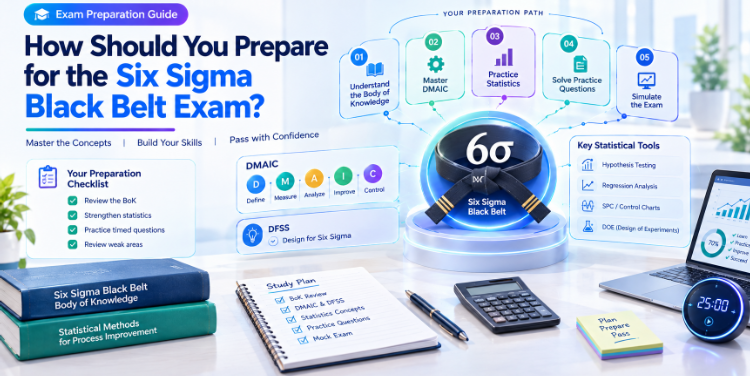
The Six Sigma Black Belt certification is an advanced credential that helps professionals develop advanced process improvement and problem-solving skills to solve complex business issues through systematic and data-driven steps. It helps businesses streamline processes for customer satisfaction and smoother operations and to achieve business goals.
You need to have a deep understanding of process improvement concepts and formulas, the ability to solve complex problems, and be able to use the DMAIC framework the right way to prepare for this exam. Having a preparation strategy can make learning these concepts easier to do and help you perform better on the exam.
This is why choosing the right preparation strategy matters, whether you are transitioning from a green belt or building up your skills in advanced process improvement techniques. If you want to strengthen your skills, then register for the Lean Six Sigma Black Belt training to learn about real-world applications of these tools and guided preparation.
What Topics Are Commonly Covered in the Six Sigma Black Belt Exam?
The Black Belt examination generally covers these areas:
- DMAIC methodology
- Lean principles and waste reduction
- Process mapping
- Statistical analysis
- Process capability
- Hypothesis testing
- Regression and correlation
- Design of Experiments (DOE)
- Control charts
- Root cause analysis
- Project management
- Team Collaboration
When you are aware of the syllabus, it can help you plan your preparation time according to how important and how difficult each topic is.
Why Should I Understand the DMAIC Framework?
The DMAIC Framework is the core of the Lean Six Sigma methodology. It is important to understand how each phase connects as a project progresses, especially in aspects like its purpose and tools used during that phase.
Below is a list of items you should learn about in each phase:
- Define: Understand the business problem, customer needs, project, and scope of the project
- Measure: Collect data to understand the current, baseline performance levels and understand how the data was collected
- Analyze: Examine the data to investigate and validate the root causes of the process defects
- Improve: Find, test, and implement solutions that address the validated causes discovered during the ‘Analyze’ process.
- Control: Set up monitoring systems, standard operating procedures, and other methods to maintain and sustain the improvements implemented.
Understanding how different phases of the DMAIC procedure work practically will help you get clarity as to why each phase is crucial for the Black Belt methodology.
Understand Statistical Concepts
Statistical concepts, although challenging, are an integral part of the Black Belt preparation. Pay particular attention to the following concepts:
- Mean, median, variance, and standard deviation
- Normal and non-normal distributions
- Hypothesis testing
- p-values and significance levels
- ANOVA
- Regression analysis
- Process capability measures such as Cp and Cpk
- Control charts
- Sampling concepts
Regular practice will help you learn the appropriate statistical tools for different process problems.
Practice Six Sigma Tools and Techniques
It is important that Black Belt candidates be clear with analytical and quality improvement tools. Brush up on techniques such as fishbone diagrams, Pareto charts, FMEA, SIPOC, control charts, process maps, and scatter charts.
Learn how to use these tools together, not in isolation. A good way to do so is by asking yourself:
- What problem does this tool solve?
- At which DMAIC phase is this tool mostly used?
- What information does this tool need?
- How will the results impact the next decision?
Asking yourself questions will make your knowledge more application-based.
Use Practice Questions and Mock Exams
Practice tests can help you identify gaps in your knowledge about the Black Belt. Begin answering topic-based questions and gradually shift towards full-length mock exams. After each practice test, inspect each and every incorrect answer carefully and understand where you missed out and which concepts require further revision.
Mock exams can also help improve the following:
- Time management
- Question interpretation
- Calculation speed
- Decision-making under pressure
- Familiarity with exam-style
Review Your Green Belt Foundation
When you have a strong understanding of the Green Belt, preparing for the Black Belt becomes a lot easier. Revise the basic and core concepts before moving to advanced methodologies if you need to. Explore the Lean Six Sigma Green Belt Certification if you would like to re-establish the basics of the Six Sigma methodologies.
Create a Realistic Study Schedule
Trying to cover the entire syllabus in a few days is not advisable. Instead, based on your available time, create a study plan. For example:
- Week 1: Six Sigma basics, Lean principles, and the DMAIC framework
- Week 2: Measure phase and measurement systems
- Week 3: Analyze phase and hypothesis testing
- Week 4: Improve phase, Control phase, DOE, and other advanced tools
- Week 5: Practice questions and mock exams
You can modify the schedule according to your experience, requirements, and availability. In the days before the exam, try to revise the concepts you feel the weakest in; avoid learning things from scratch.
Prioritise Application, Not Memorisation
Connect the concepts learned in the Black Belt syllabus to real-life examples. A Black Belt professional uses Six Sigma principles to solve real-world business and process problems.
For instance, learn how you can apply maps like the SIPOC in potential business processes. These types of applications help you deal with scenario-based questions a lot more easily.
Conclusion
The Six Sigma Black Belt certification is an important credential to help you lead advanced business process initiatives. To prepare well, you need to have a deep conceptual understanding, practice statistical tools, and be familiar with how to use these tools in real life. To study efficiently, understand the syllabus and develop a strong foundation in the basic concepts. With the right preparation and practice, you can prepare with a stronger understanding of the Lean Six Sigma methodology and perform in the exam with confidence.