
If you are stepping into investing for the first time, the stock market can feel loud and confusing. Charts blink on your screen. Numbers move fast. In the middle of this noise, two terms show up again and again: Demat Account and Trading Account.
Many people think they are the same. They are not.
This guide explains the difference between a demat account and a trading account in simple language, with real Indian context. By the end, you will know what each account does, how they work together, what they cost, and which one you need.
Are Demat Account and Trading Account the Same?
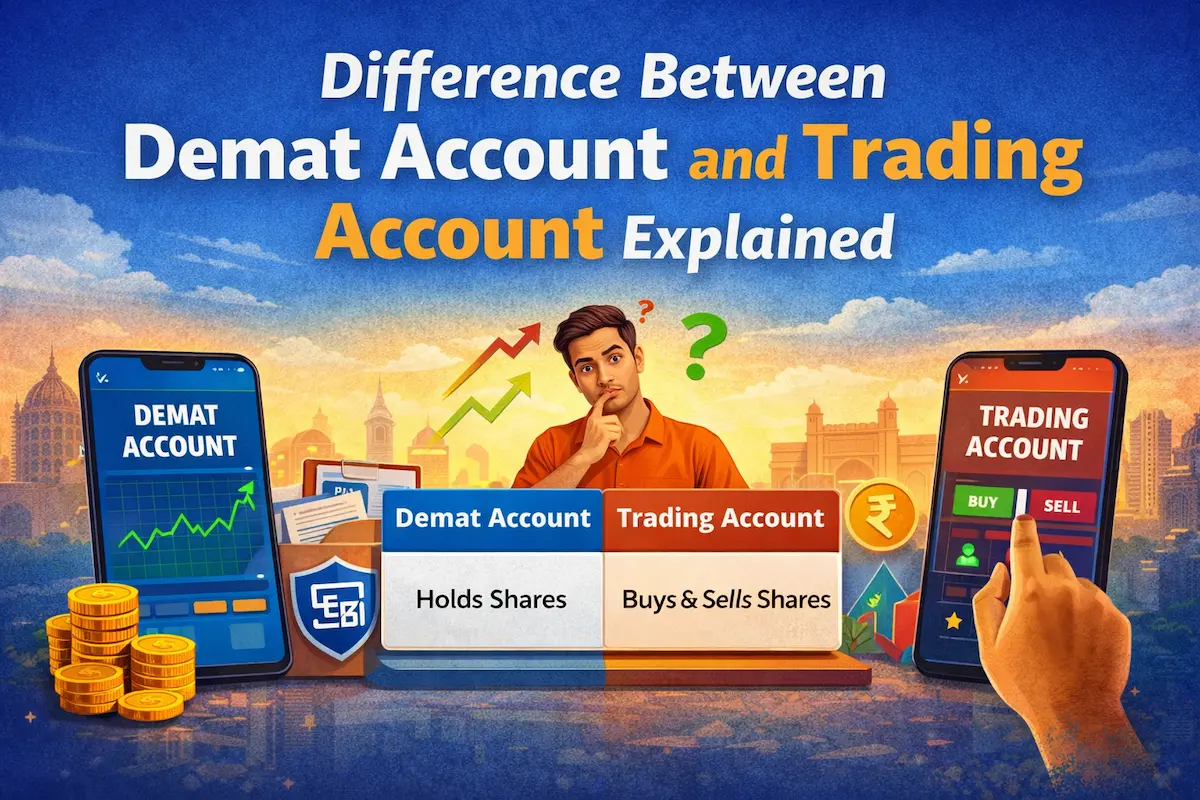
No. A Demat Account stores your shares in digital form. A Trading Account lets you buy and sell shares on the stock market.
One holds your investments quietly in the background.
The other handles action—buying, selling, and placing orders.
Most investors in India need both.
What Is a Demat Account?
A Demat Account acts like a digital locker.
Instead of holding physical share certificates that smell of old paper and ink, your shares stay in electronic form. You open your app, tap “Holdings,” and see everything clearly—quantity, value, profit, and loss.
When you buy shares:
- They appear in your demat account after settlement
- No courier arrives
- No document needs signing
In India, demat accounts operate under regulated depositories:
- NSDL
- CDSL
These institutions hold your securities safely, even if your broker changes.
What Is a Trading Account?
A Trading Account is your action tool.
It connects you to stock exchanges like NSE and BSE and lets you place buy or sell orders. When you tap “Buy” on your phone and feel that small rush—that action happens through your trading account.
A trading account:
- Executes trades
- Sends orders to the exchange
- Links your bank account to the market
Once the trade finishes, the trading account steps aside. Your demat account then takes over and stores the shares.
Demat Account vs Trading Account: Quick Comparison Table
| Feature | Demat Account | Trading Account |
| Main role | Stores shares digitally | Buys and sells shares |
| Purpose | Safe holding | Market execution |
| Works with | Depositories | Stock exchanges |
| Used when | After settlement | During trading |
| Visible activity | Holdings, statements | Orders, trades |
| Charges | AMC, DP fees | Brokerage, taxes |
This table answers most beginner doubts in seconds.
How a Trading Account and Demat Account Work Together
Think of a local vegetable market.
You place an order with the vendor.
The vegetables come home and sit in your kitchen.
The trading account places the order.
The demat account stores what you bought.
Here is the exact flow:
- You place a buy order using your trading account
- The stock exchange matches it
- Money moves from your bank account
- After settlement (T+1 or T+2), shares appear in your demat account
You see only the smooth result, not the wiring underneath.
This teamwork is why you usually open both accounts together.
When Do You Need a Demat Account vs a Trading Account?
You need a demat account if:
- You invest for the long term
- You hold shares, ETFs, or mutual funds
- You apply for IPOs
You need a trading account if:
- You buy or sell shares actively
- You place intraday or delivery orders
Most Indian investors need both, even if they trade once a year.
Someone buying shares for ten years still needs a trading account to make the purchase. After that, the demat account quietly holds the investment.
Types of Demat and Trading Accounts
Not all investors look the same, so accounts come in types.
Types of Demat Accounts
- Regular Demat Account
Used by resident Indians. - Basic Services Demat Account (BSDA)
For small portfolios under ₹2 lakh. Charges stay lower. - NRI Demat Account
Used by Indians living abroad, with repatriation rules.
Types of Trading Accounts
- Discount Broker Trading Account
Lower brokerage, app-first design. - Full-Service Broker Trading Account
Higher fees, more hand-holding, research support.
Your choice depends on how often you trade and how much guidance you want.
Charges: Demat Account vs Trading Account
Money matters feel real when fees hit your statement.
Demat Account Charges
- Account Opening Fee: Often free
- Annual Maintenance Charge (AMC): ₹300–₹750 per year
- DP Charges: Applied when you sell shares
- Pledge Charges: If you pledge shares for margin
These costs feel slow and steady, like a service bill.
Trading Account Charges
- Brokerage: Charged per trade
- STT and Exchange Fees
- GST and Stamp Duty
If you trade often, these numbers matter a lot. Even small charges add up over time.
Reading the tariff sheet before opening an account saves frustration later.
Are Demat and Trading Accounts Safe in India?
Yes, if you stay alert.
Both accounts operate under rules set by Securities and Exchange Board of India.
Your shares stay with NSDL or CDSL, not with the broker directly. Even if a broker shuts down, your holdings remain safe.
You stay protected by:
- Never sharing OTPs
- Avoiding unknown links
- Checking transaction statements monthly
Safety comes from awareness as much as regulation.
How to Open and Link a Demat Account and Trading Account
Opening accounts today feels smooth and quick.
Step-by-Step Process
- Choose a broker or bank
- Upload PAN, Aadhaar, and bank proof
- Complete online KYC and video verification
- Link your bank account
- Receive login details within 24–48 hours
Most platforms open both accounts together. You do not need to apply separately unless you want accounts with different providers.
The first login often feels exciting. Your dashboard looks clean, empty, and full of possibility.
Common Mistakes Investors Make
Beginners often stumble in predictable ways.
Mistake 1: Mixing Up Roles
They expect trades to show instantly in demat holdings.
Mistake 2: Ignoring Charges
AMC and DP fees surprise them later.
Mistake 3: Sharing OTPs
This exposes accounts to fraud.
Mistake 4: Opening Too Many Accounts
Multiple accounts feel exciting but increase complexity.
Avoiding these mistakes keeps investing calm and controlled.
Which One Should You Open First?
If you are just starting:
- Open both together
- Keep trading slow in the beginning
- Learn by watching your holdings grow
Long-term investors can stay quiet for months. Active traders check screens daily. Both paths work if you understand the tools.
Understanding the Difference Brings Clarity
The stock market feels less scary once roles feel clear.
A trading account handles action.
A demat account handles storage.
They work together, like hands and pockets. One reaches out. The other keeps things safe.
When you understand this difference, investing becomes calmer, more deliberate, and easier to manage. That clarity matters more than chasing quick profits.
Next Read: What Is a Demat Account?